Week 2: What is Your Health Philosophy?

It’s Week Two of the Health Shift Book Club!
We’re talking about chapters 5-6.
Welcome, everyone!
Last week focused on the world around you. This week, we’re talking about the person making the decisions. (That’s you!)
If you’re just joining us, hello! I’m the author, Dr. Alice Burron.
This week, we’re going to work through chapters 5-8. No worries if you don’t want to dig into the entire chapters…. we’re breaking it down in the Quick Notes below!
We’ll be discussing these chapters during this week’s Live Session on August 12th at 12:00pm MST. We’d love for you to join us. (Question Submissions are now closed.)
Let’s hop in.
Before you can confidently navigate your health, you need to know who is doing the navigating. That's the reason I wrote this section. I wanted to help you discover your own health philosophy—the beliefs, values, priorities, and boundaries that shape how you want to approach your health. Without that foundation, it's easy to be pulled in every direction by persuasive messages, conflicting advice, and someone else's definition of what health should look like.
One of the greatest obstacles to better health isn't always what's happening around us—it's what we don't yet understand about ourselves. Our natural tendencies, habits, fears, strengths, and decision-making patterns all influence the choices we make. The goal isn't to become someone else. It's to understand yourself well enough to work with your strengths, recognize when your instincts may not be serving you, and make health decisions that align with the person you want to become.


Chapter Five: Defining Your Compass
Health is more than the absence of disease. It encompasses physical, mental, emotional, and even spiritual well-being. Because of this, making good health decisions requires more than simply reacting to symptoms or following the latest recommendation. It requires understanding what health means to you and what kind of future you are working toward.
Big Idea: Building a Health Philosophy
A health philosophy is the collection of beliefs, values, and priorities that shape how you think about health and healing. It acts as a compass, helping you evaluate choices and stay aligned with what matters most.
When your decisions support your health philosophy, they tend to feel purposeful and satisfying. When they don't, you may experience frustration, doubt, or a sense that something isn't quite right—even if the decision appears successful on the surface.
To develop a health philosophy, begin by considering what health means to you. What role does prevention play in your life? How do you view conventional and alternative medicine? How you define healing, and what do you want your future healthy self to look like?
Click here to download a bonus guide to creating your health philosophy.
Once these ideas become clear, they can serve as a foundation for everything that follows. This chapter also introduces a simple framework for turning philosophy into action:
Health Philosophy: Your vision and guiding beliefs about health—the destination.
Health Approach: The general path you choose to reach that destination, such as conventional medicine, lifestyle change, holistic practices, or a combination of approaches.
Health Plan: The practical roadmap that outlines the specific strategies you will use.
Health Goals: The measurable actions and milestones that move the plan forward.
In short, a health philosophy is visionary, a health approach is strategic, a health plan is actionable, and health goals are targeted.

Chapter Six: Taking Control of Your Decisions
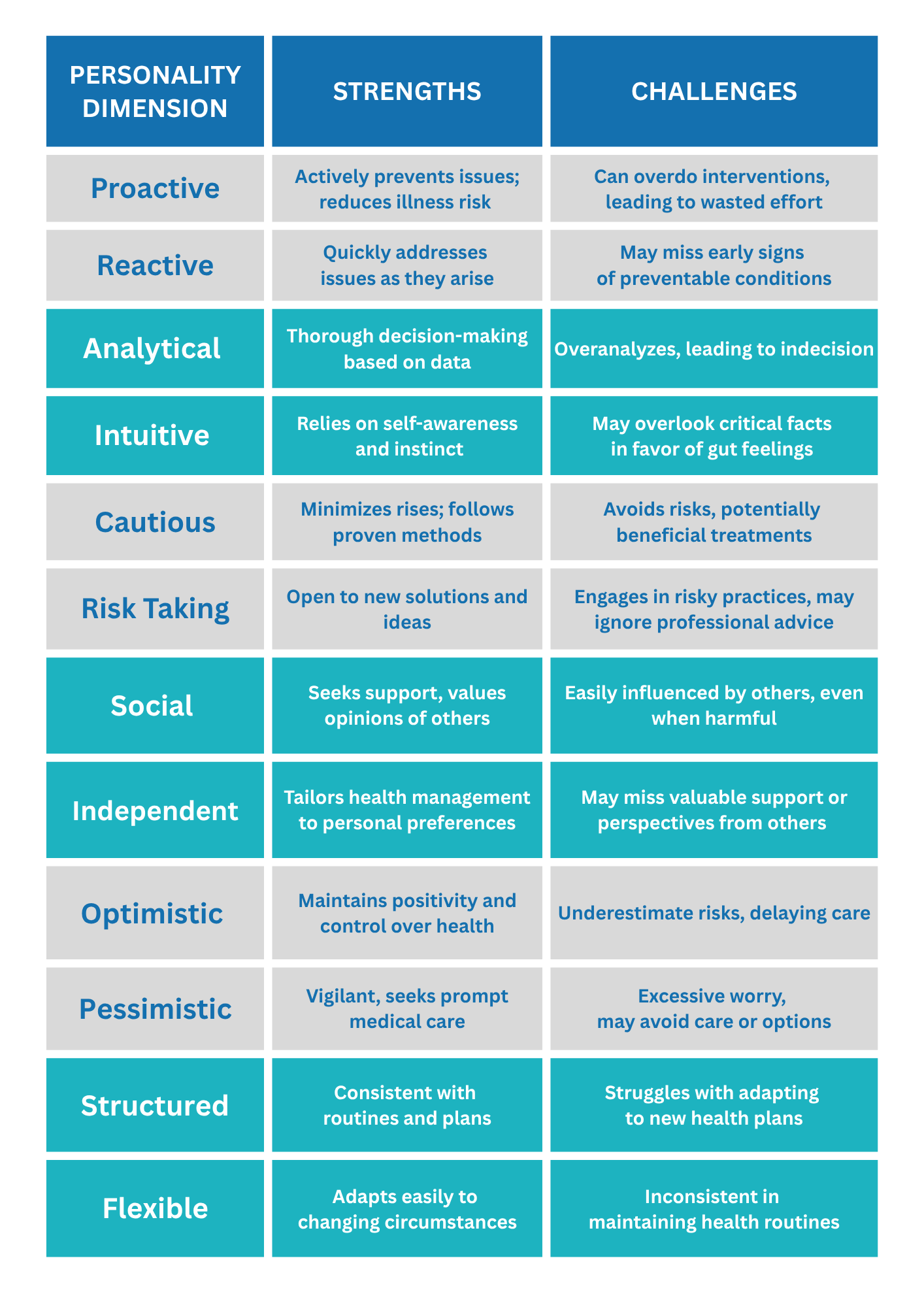
A better understanding of your personality and decision-making style can help you recognize your strengths, avoid common pitfalls, and make health choices that align with who you are.
Big Idea: Your Personality Shapes Your Health Decisions
We often assume health decisions are driven by information alone, but personality plays a major role in how we approach our health!
Some of us overthink every option, while others brush off warning signs and assume things will work themselves out. Neither extreme serves us well.
The goal isn't to change who you are—it's to understand yourself well enough to recognize your strengths, anticipate your blind spots, and make better decisions as a result. Every personality trait offers advantages, but every trait can also become a liability when taken too far.
This chapter introduces six personality dimensions that influence how we manage our health:
Proactive vs. Reactive – Do you focus on prevention, or do you address problems as they arise?
Analytical vs. Intuitive – Do you rely primarily on research and data, or on instinct and self-awareness?
Cautious vs. Risk-Taking – Do you prefer proven methods, or are you willing to explore new approaches?
Social vs. Independent – Do you seek input from others, or prefer to manage health decisions on your own?
Optimistic vs. Pessimistic – Do you naturally expect positive outcomes, or do you focus on potential risks?
Structured vs. Flexible – Do you thrive with routines and plans, or adapt easily as circumstances change?
There is no perfect combination of traits. The key is recognizing which tendencies help you move forward and which ones may quietly undermine your progress.
Big Idea: Your Decision-Making Style Matters Just as Much
Beyond personality, we each have a preferred way of making decisions. Understanding this tendency can help us avoid common mistakes and make more balanced health choices.
To help us grasp how we think, there’s a useful tool for understanding ourselves. The acronym is C-BAD — it represents four decision making styles that most of us fall into. See if one of these resonates most with you. (You can also take this short quiz!)
Conceptual – Big-picture thinkers who are open to unconventional ideas, alternative approaches, and innovation. Their strength is creativity; their challenge is overlooking practical realities or evidence.
Behavioral – People-oriented decision-makers who rely heavily on emotions, relationships, and how a choice feels. Their strength is empathy and connection; their challenge is allowing feelings to outweigh facts.
Analytical – Data-driven decision-makers who want information, research, and evidence before acting. Their strength is thoroughness; their challenge is overanalysis and delayed action.
Directive – Fast, decisive decision-makers who prefer efficiency and clear answers. Their strength is action; their challenge is moving too quickly and missing important considerations.
The most effective health decisions come from understanding your natural style while intentionally borrowing strengths from others. A conceptual thinker may need more evidence. An analytical thinker may need to act sooner. A behavioral thinker may need to pause before following emotions. A directive thinker may need to slow down and explore additional options.
Better health decisions begin with better self-awareness. When you understand both your personality and your decision-making style, you're better equipped to avoid predictable pitfalls and leverage your strengths.