Week 1: The Hidden Forces That Shape Your Health Decisions
It’s Week One of the Health Shift Book Club!
We’re talking about chapters 1-4.
Welcome, everyone!
I’m so glad you’ve decided to join us for the Health Shift Book Club. I’m the author, Dr. Alice Burron, and I’ll be your guide through this journey.
This week, we’re going to work through chapters 1-4. No worries if you can’t read all four chapters…. we’re breaking it down in the Quick Notes below!
At the very bottom, you’ll find Bonus Resources to help you get the most out of your Health Shift experience, as well as helpful tips, ideas, and resources sprinkled throughout this book club.
We’ll be hosting a Live Session featuring your questions about this week’s section on August 5th at 12:00pm MST. If you have a question you’d like to ask, submit it at the top of this page. (Question Submissions are now closed.)
I can’t wait to hear from you. Now, without further ado, let’s dive in.
One of the biggest reasons I wrote this section of Health Shift is that I saw so many people feeling lost about their health. Everywhere they turned, someone was offering advice, promoting a solution, or promising the answer. People weren't lacking information—they were drowning in it. When you're worried about your health, that kind of overload can leave you feeling vulnerable and unsure of what to do next.
I wanted to begin the book by helping you find your "true north." My hope is that these chapters remind you that you have more influence over your health journey than you may realize. You don't have to react to every headline, opinion, or recommendation. Instead, you can learn to pause, think strategically, and confidently choose your next best step. That's where Health Shift begins.

Introduction: Taking Control of Your Health Destiny
In our everyday lives, it’s all too easy to feel more like a victim than a superhero when it comes to our health. The truth is, we’re up against powerful forces that often seem determined to undermine our well-being. The healthcare system can feel like a maze — in fact, 65% of Americans feel overwhelmed by the complexity of the healthcare system, leading to delayed or avoided care.
Whether you’re dealing with a chronic condition like lupus, chronic fatigue, or diabetes, or are grappling with persistent and annoying health issues like headaches, anxiety, or heart palpitations, this book is about getting to the root of the issue and connecting you to the best possible solution for you.
Maybe you’re not currently dealing with an ailment. If that’s the case, these principles are great to keep in your back pocket for when that time inevitably arises. This book is also intended to help caregivers on a health journey with a loved one.
Health is a continuum, not a destination. We never arrive at ‘perfectly healthy,’ and if we do, it’s always evolving and changing. In a reactive, healthcare-based culture, it can be incredibly useful to come up with a plan and a health philosophy before you run into a health issue.
By reading this book (or these Quick Notes), you’ll gain the knowledge and tools to break free from these challenges. You’ll feel empowered to make informed decisions that truly benefit your well-being.
The journey to better health starts with understanding the battlefield.
Chapter One: Turning Complacency Into Curiosity
Lots of people come to me feeling uncertain about issues like high cholesterol or blood pressure. Their doctors have prescribed medication, but they’re hesitant — unsure if they should take it, or if there might be another way.
Many have an unspoken philosophy: they’d rather try something else first before relying on medication.
More often than not, with a little guidance and curiosity, my clients are able to lower their numbers into a healthy range within a few months without medication. Their open-minded willingness to explore beyond the first option opens the door to new ways of healing.
And for those who do ultimately choose medication, there is a sense of peace knowing they explored all of their options, not settling for a quick fix. They made an informed decision, leaving them with confidence and contentment.

Unfortunately, most of us don’t approach health this way. We live in a quick-fix culture, one that prioritizes treating conditions after they appear, rather than focusing on prevention and continuous healing.
So, let’s begin this journey by exploring why it’s so difficult for us to make good decisions, and uncover why humility and curiosity may just be the most powerful superpower you can wield to counteract the self-defeating tendencies that hold you back from being at your best health.
Big Idea: The Surreptitious Seven Tendencies
The first step is to discover ourselves and the tendencies that are getting in the way of our best future self. I call them the Surreptitious Seven Tendencies.
1) Our natural inclination to react, and often overreact, to a health scare rather than preventing it in the first place.
2) Ignoring our body’s invaluable signals and reactions.
3) Not considering how our feelings play into our health decisions, since emotions can often stealthily cloud health choices.
4) Becoming overwhelmed by information; struggling to filter out noise from helpful health advice.
5) Overlooking alternatives (like exploring options beyond the doctor’s office).
6) Failing to strategically evaluate our health and health improvement efforts.
7) Lacking health humility — the idea that we don’t have all the answers.
Big Idea: Health Humility
Health humility is an open-minded, learning mindset that allows us to question and seek out information. The opposite of health humility is health arrogance — that is, thinking we can outsmart biology, ignoring symptoms, being easily persuaded to try random approaches, or believing lies about our health when we shouldn’t.
Health isn’t a destination. It’s a way of being. It’s not something to manage, like paying bills; it’s a continuous part of who we are. It affects how we live. It’s woven into our very existence.
So, to engage with health humility and start to understand our health decision making, we start by embracing curiosity around our health.
You’re now stepping into the role of a Health Hero — a navigator of health challenges, taking charge of your wellbeing.
We have to change our thinking in order to change our health.
Chapter Two: Recognizing Thinking Patterns That Hold You Back
Our greatest adversaries hide within us, subtle biases and mental shortcuts that can cloud our judgement and steer us off course when we least expect it. The worst part is that we’re often totally unaware that this is happening!
The catch-22 here is that we all have a hard time recognizing our self-limiting beliefs… because we’re limited in our thinking. This, again, is where health humility can help us out. We have to be willing to recognize (or at least admit) that limiting beliefs are getting in the way of our best health.
Big Idea: Limited Thinking Leads to Limited Healing
Do you recognize some of these common beliefs?
“I’m not enthusiastic or excited about being intentional about my health, so it’s not that important to me.”
Maybe taking care of yourself feels like it will take too much time, too much work, or be unrewarding. True, the journey to better health does take time and energy, but so do other aspects of life (like on oil change, or cleaning the bathroom!)
This is a perfectly normal response, especially at the beginning. But often, after getting into the routine of addressing our health, we begin to feel better. Eventually, it’s an essential part of your day or week. This will happen to you too, if you remove the belief that taking care of yourself is always going to feel miserable or be hard.
“I don’t have enough time to focus on my health — I’m too busy.”
If this self-limiting belief resonates with you, believe me, I can relate! The limiting belief here is that time is the enemy, but the truth is, health just hasn’t been prioritized.
Why is that? What is keeping you from spending time on your health? Is it that you don’t know where to begin? Be curious. Ask yourself why, and don’t judge your own answers. We create the limiting belief, so we can overcome it, too. It just takes patience and self-honesty.
“I’m already doing everything I can to heal (an ailment) or to be healthy.”
The truth is, none of us are doing everything possible. Maybe you’re doing your best — but that’s different.
There are always other options we can try. In fact, options are limitless. Additionally, what used to work in the past doesn’t always translate to the future. Health is always changing, and our approaches should change with it.
Big Idea: Biases
When navigating our health, we are all susceptible to mental shortcuts and blind spots that can quietly shape our decisions.

There are a lot of biases that impact our health. (Click on the resource on the left to download a list of biases that specifically relate to our health!)
Together, these biases remind us that health decisions are rarely made from a place of perfect logic. In fact, a place of perfect logic simply doesn’t exist.
The goal is not to eliminate these tendencies entirely, but to recognize them, challenge them, and make thoughtful decisions based on evidence, self-awareness, and a willingness to adapt as we learn.
Chapter Three: Swim Upstream in the Culture Current
Every single human on this planet lives within a culture. From the foods we eat and the beliefs we inherit to the people we spend time with and the healthcare systems we navigate, culture shapes our health decisions every day. Most of the time, we aren't aware it's happening. We simply absorb the attitudes and habits around us and assume they're normal.
Big Idea: Culture Is Constantly Shaping Your Health Decisions
Family traditions, childhood experiences, friend groups, workplaces, social media, and the broader U.S. health culture all shape how we think about health. Some of these influences support our well-being, while others can quietly push us away from it.
It helps to become students of our own environment. Where did our beliefs about food, exercise, healthcare, and healing come from? Which influences are helping us thrive, and which ones deserve to be challenged?
Awareness is the first step toward making health decisions that align with our own goals and values rather than simply following the crowd.
Big Idea: Awareness Helps Us Swim Upstream
Humans are wired to imitate the people around them. We naturally adopt the behaviors, attitudes, and expectations of our tribes, often without realizing it. That's why who we spend time with matters so much.
Living a health-conscious life can sometimes feel like swimming against the current, especially in a culture that often focuses on treating illness rather than preventing it. But the goal isn't to reject culture entirely. The goal is to recognize its influence and choose intentionally which currents to follow.
By becoming more aware of the cultural forces acting on us, we gain the ability to navigate our health journey with greater confidence, clarity, and purpose.
Chapter Four: Navigating A Complex Information Landscape
We’ve come across one of the greatest challenges facing modern Health Heroes: navigating a world overflowing with health information. Every day we are exposed to advice from websites, books, social media, healthcare providers, friends, family members, and now artificial intelligence.
The problem is not a lack of information; it is learning how to separate useful information from noise, marketing, bias, and misinformation. Good health decisions begin with good information… but finding it requires some strategy.
Big Idea: Search with Curiosity
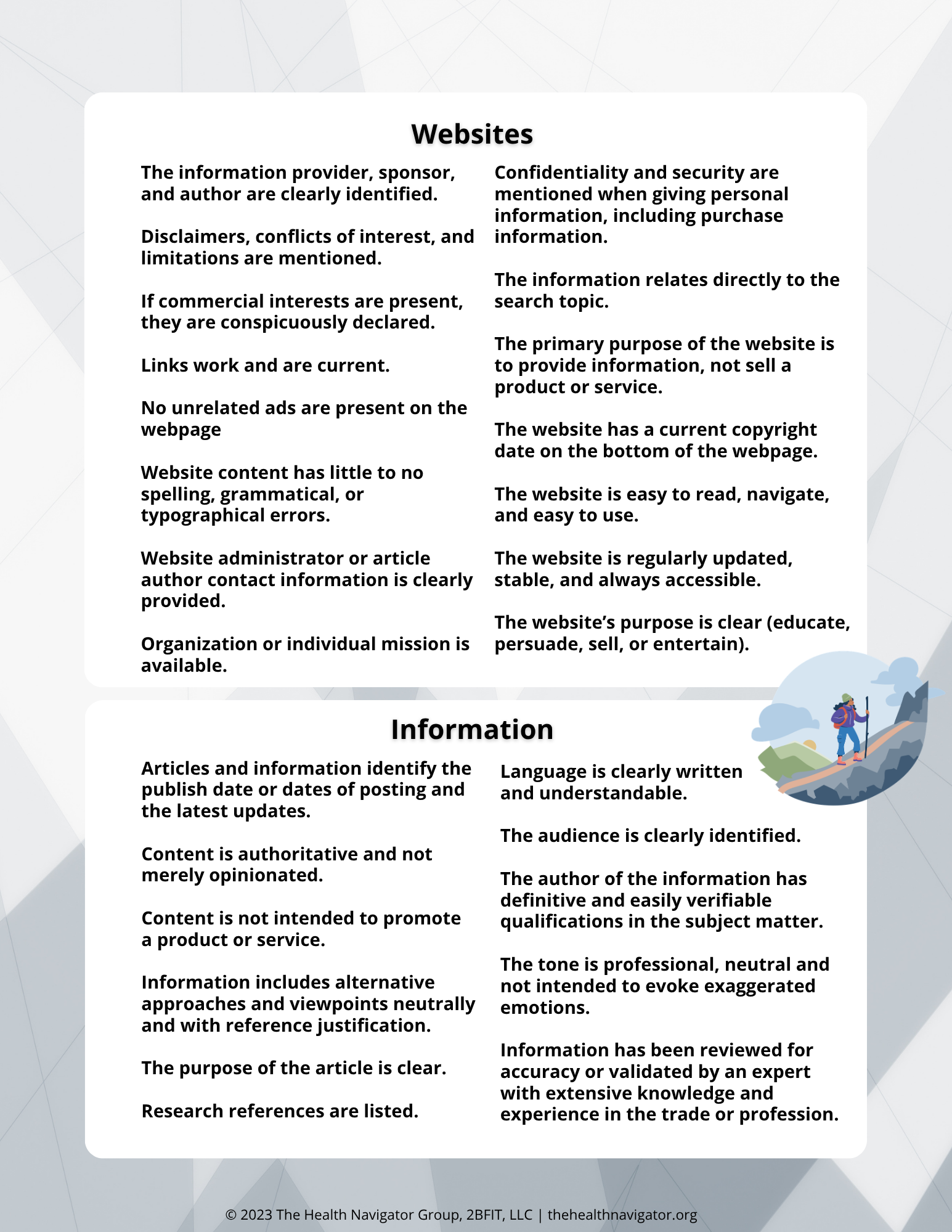
When searching for answers, it is important to avoid placing too much trust in any single source. Instead, approach health questions with curiosity. Use specific search terms, seek out reputable organizations and research, ask yourself what information might be missing, and compare multiple perspectives before drawing conclusions.
(You can learn about how to source quality information by clicking on the resource to the right!)
The goal is not to find information that confirms what you already believe, but to develop a complete understanding of the situation from multiple angles.
Time spent investigating a health decision before committing to it can save significant frustration, expense, and unintended consequences later.
Healthcare professionals, scientific studies, health guidelines, friends, family, and online communities all have value to offer, but each source also has limitations. Doctors are human. Research evolves. Guidelines can conflict. Stories and testimonials can be persuasive without being representative. The healthiest approach is to gather information from multiple angles, weigh the evidence, and remember that health decisions ultimately belong to you.
Perhaps the most important lesson is this: never rely on a single source. Health information is strongest when it is supported by multiple trustworthy perspectives. Stay curious. Stay objective. Continue asking questions. The quality of the information you choose to trust can profoundly influence the quality of the decisions you make, and ultimately, the trajectory of your health journey.